Track and trace
- Driver and carrier check calls
- ETA collection
- Portal monitoring
- TMS status updates
- Shipment notifications

Add dedicated bilingual capacity for track and trace, customer updates, POD follow-up, appointment scheduling, billing preparation, and other recurring logistics work, without handing over the decisions your operation needs to control.
Freight brokers3PLsTransportation companiesU.S. and Canadian operations
Your internal team does not need to spend every hour chasing routine updates, documents, and follow-ups. Optimus takes ownership of defined execution workflows while your operation keeps control of pricing, customer commitments, carrier strategy, and material exceptions.
Map your workflow with usExtended, overnight, and weekend coverage is scoped and priced after assessment.
Optimus is not a “give us your department” provider. You decide where the authority line sits, and the pod works on the execution side of it.

| Optimus can execute | Your team retains |
|---|---|
| Track and trace | Pricing decisions |
| Routine carrier follow-up | Carrier strategy |
| Customer status updates | Customer concessions |
| Document collection | Claims decisions |
| Appointment coordination | Non-standard commitments |
| Billing preparation | Credits and write-offs |
| Exception documentation | Material exception decisions |
You define the authority boundary before launch.Routine work follows documented workflows. Anything outside the agreed rules follows a defined escalation path back to your team.
When brokers and account managers spend too much of the day on status checks, documents, appointments, and routine follow-up instead of customers and carriers.
When growing shipment volume creates more execution work across customers, carriers, portals, and internal systems.
When internal teams need more administrative and customer-facing capacity around dispatch and shipment execution.
When another U.S.-based hire would solve capacity but also add recruiting, supervision, and overhead.
Most outsourcing conversations start with “how many agents?” Ours start with the work: what comes in, what goes out, and who decides when it does not go to plan.
We identify the recurring work, systems, inputs, outputs, and handoffs.
We document what the Optimus team executes independently and what must be escalated, and to whom.
Optimus recruits and prepares the dedicated bilingual personnel the agreed workflow requires.
Work runs through documented processes with the agreed supervision, QA, reporting, and escalation structure.
An illustrative operating flow. Your SOPs set the check-call cadence, update templates, and escalation rules; the pod runs them on every active load.
Both models give you dedicated bilingual personnel employed by Optimus. The difference is who runs the operation day to day.
Add capacity and the management layer with it.
Optimus handles
Already manage the operation yourself?
You keep
Optimus handles the defined Colombian workforce-administration layer. Fees start at US$299 per employee per month, separate from employment cost.
Explore Transition Pods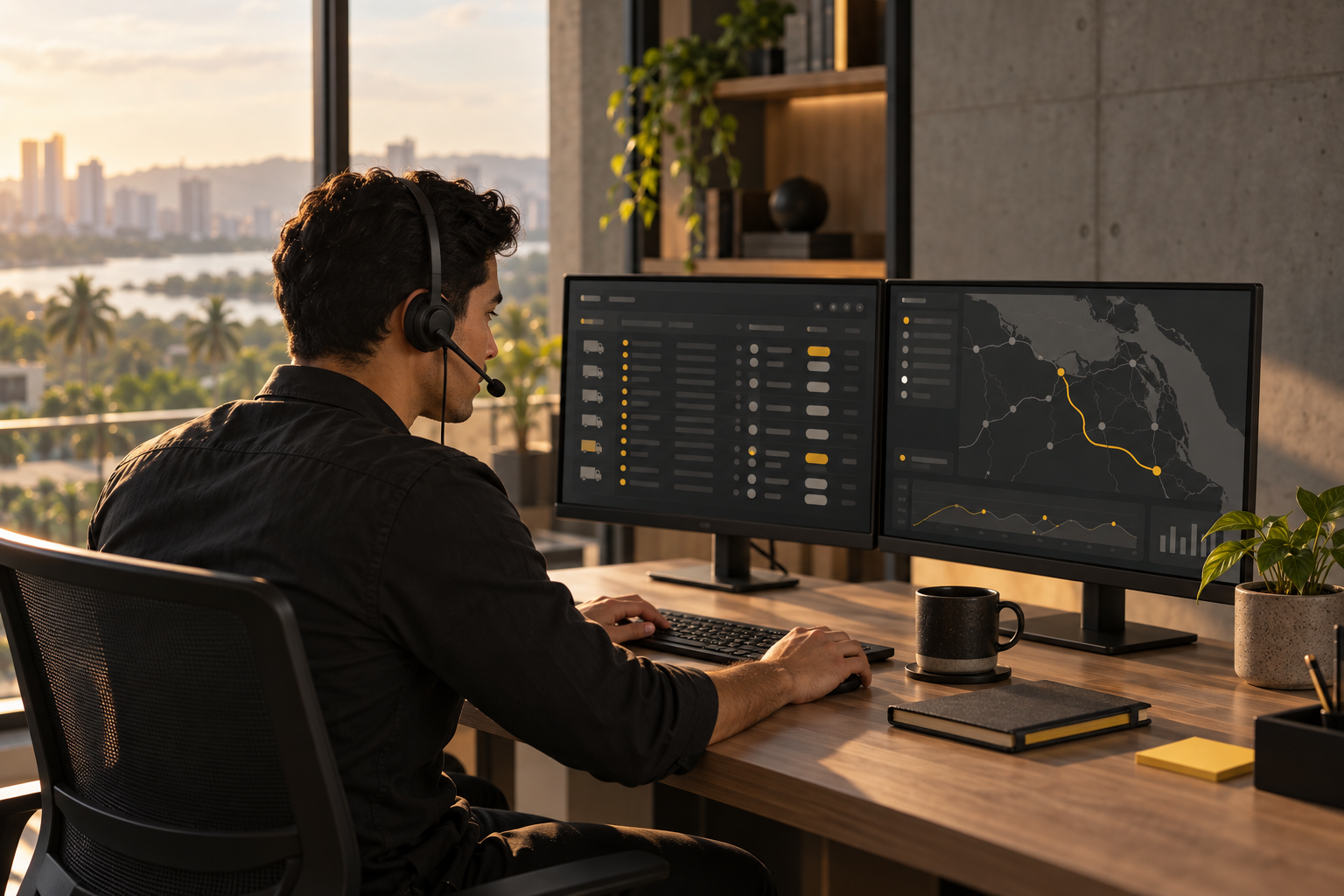
Practical guides for deciding what to delegate, how a nearshore team is built, and how the economics compare with hiring locally.
Don't see your question? Send a workflow brief and we'll answer it against your actual operation.
Send a Workflow BriefRecurring execution work with clear inputs and rules is the best fit: track and trace, check calls, customer status updates, POD and document follow-up, appointment scheduling, billing preparation, carrier communication, and TMS record maintenance. Decisions that commit money, risk, or customer relationships, such as pricing, claims, concessions, and carrier strategy, usually stay with your team. The assessment documents that line before anything launches.
Yes. Optimus teams work in the client-approved systems your operation already uses, including your TMS, carrier portals, email, and phone tools, with the permissions you grant. Access, policies, and data handling are part of the operating plan. Working in your TMS does not imply a software integration, data connection, or implementation timeline; those requirements are evaluated and documented first.
Yes. Track and trace is one of the most common workflows to delegate. The pod runs check calls, collects ETAs, monitors portals, updates the TMS, and sends routine customer updates. When something falls outside the agreed rules, such as a missed appointment or a service failure, the team documents it and escalates it through the path you define.
It can be scoped. Standard schedules align with U.S. Eastern, Central, or Pacific business hours. Extended hours, overnight shifts, weekends, holidays, and twenty-four-hour coverage are not included by default; availability and pricing are set after we assess load patterns, handoffs, and the escalation rules the after-hours team must follow.
Yes. A Managed Pod may begin with one dedicated bilingual coordinator under shared Optimus lead oversight. Starting with a single, well-defined workflow is often the cleanest way to prove the operating model before adding capacity. Team size and leadership depth grow with the workflow and the scope you agree.
Yes. Logistics pods are designed for freight brokers, third-party logistics providers, and transportation companies serving U.S. and Canadian freight. The work is built around shipment execution, including loads, carriers, documents, appointments, and customer communication, rather than generic call-center scripts.
Optimus Innovations is a Colombian company, and teams work from Barranquilla, Colombia. Delivery can be remote under defined requirements or office-based in partner space in Barranquilla, subject to availability and scope. Optimus does not have a U.S. office.
Optimus employs the personnel in both models. In a Managed Pod, Optimus also provides the management layer: a named supervisor, routine QA, weekly visibility, a monthly review, and escalation. In a Transition Pod, your managers keep daily direction, scheduling, performance management, and operational QA, while Optimus handles the agreed workforce-administration responsibilities.
Show us the recurring work consuming your team's time. We will help identify what can be delegated, what should stay under your control, and which operating model fits the workflow.